Ramadan Charter Handling in Kuwait: Planning the Spike
Ramadan is the busiest charter window of the year for most ground handlers in the Gulf, and Kuwait is no exception. Schedule patterns shift around iftar and suhoor; passenger flows on the Hajj and Umrah feeder routes climb in the weeks before and after the month; catering uplift profiles change overnight; and the airport’s own working hours adjust. Charter operators who fly through KWI for one-off movements during Ramadan need to plan against all of that. This briefing sets out what changes during the month, what the cargo and passenger flow looks like, and the lead time we ask charter desks to give us so the handling is not improvised.
What changes when the month begins
The most visible change is the schedule. Government and many private offices in Kuwait shift to reduced working hours during Ramadan; banks, customs, and other airport-side state agencies follow the same pattern. The airport itself stays open 24 hours, but the rhythm of the working day moves. Slots in the late morning and early afternoon thin out as charter operators avoid the midday heat-and-fasting overlap. The window from roughly an hour before iftar through about two hours after the prayer is the quietest period of the day on the apron — most flights either land before iftar or schedule the turnaround to begin once the meal is finished. From late evening through to the suhoor period before dawn, traffic intensifies. Charter operators who can flex their schedule into the late-night and early-morning bands generally get better slot availability and faster turnarounds.
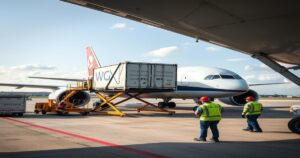
The second change is on the cargo side. Pre-Ramadan, there is a significant uplift in foodstuffs, dates, and consumer goods landing in Kuwait for the month. The KWI cargo desk sees the spike begin two to three weeks before the start of the month, with perishables peaking in the final week. Charter freighter movements during this window are common, and the bonded warehouse plans for higher than usual throughput on perishables and general cargo lanes. Outbound, the pattern reverses in the days before Eid as gift and personal-effect shipments climb.
Hajj and Umrah feeder traffic
Kuwait sits on the regional feeder network for Hajj and Umrah. The pre-Ramadan and Ramadan windows are the most active Umrah periods of the year, and the post-Ramadan window into the Hajj season carries elevated charter movement on the Saudi sectors. Wide-body charters on the Jeddah and Medina routes are common; narrow-body movements on regional feeders into KWI from secondary points in the Levant and South Asia run alongside them.
From a handling planning point of view, this matters for two reasons. First, capacity at peer airports in the region tightens, which affects diversion options if KWI weather closes down or if a slot is missed. Second, ground equipment and crew positions are at higher utilisation across the apron — there is less slack in the system for an unexpected late-arriving charter. Charter operators who plan their own schedule around the Hajj and Umrah peaks get better resource confirmation.
Slot, permit, and overflight coordination
Slot allocation at KWI for ad-hoc operators runs through the same coordination channel during Ramadan as the rest of the year, but lead times stretch. Diplomatic clearance and overflight permit windows for transit through GCC airspace can take longer to confirm because the issuing authorities are also on reduced working hours. We ask charter operators to start the landing permit coordination earlier than normal — five working days as a planning assumption rather than the three days we are comfortable with outside Ramadan. For charters that involve overflight of multiple GCC states, the longest single permit response in the chain sets the timeline; budgeting an extra forty-eight hours in the schedule absorbs most of the variability.
Catering and on-board service shifts
Catering uplift profiles change during Ramadan in a way that operators flying their first Ramadan rotation through Kuwait sometimes underestimate. Inbound flights arriving close to iftar carry a passenger load that has been fasting for the full day; the meal service profile, water and date provision, and the timing of the cabin service are typically adjusted to match. Outbound flights departing during the suhoor window carry a different profile again. The catering uplift at KWI is planned against the airline’s standard menu but the timing — when the trolleys leave the kitchen, when the high-loaders arrive at the aircraft — is calibrated to the prayer schedule for the day. Operators who specify their preferred service timing in the pre-flight planning brief get a smoother handover than those who leave it to be resolved on the day.
Crew rest and duty considerations
Charter operators rotating fasting crew through Kuwait during Ramadan often request specific hotel and transport arrangements that match the meal schedule. Rooms with iftar and suhoor service, transport timing that does not conflict with prayers, and quiet rest periods through the early afternoon are all common. The crew arrangements desk works against the operator’s stated preferences rather than a default — there is no single template that suits every operator, and we do not assume one. Subpart Q rest compliance does not change for Ramadan, but the practical arrangement of that rest window does, and it pays to brief the desk in advance rather than discover the constraint at hotel check-in.
The lead time we ask for
Outside Ramadan, a one-off charter through KWI can usually be set up on three or four days of lead time for routine operations. During Ramadan, we ask for five to seven working days. That number absorbs the longer permit cycle, the tighter slot availability around iftar and suhoor, the higher cargo throughput in the bonded warehouse, and the reduced working hours of the state agencies that have to sign off elements of the movement. Late requests can be accommodated where the operator is flexible on slot timing — typically by accepting a late-night or early-morning slot instead of the daytime window the operator originally wanted — but the cleanest charters are the ones planned with that buffer.
Charter operators with Ramadan movements through KWI on the schedule can scope the handling, catering, crew, and permit work through the RFQ form and our desk will return a coordination plan that names the slot windows, the lead times for each element, and the documentation we need. The earlier the conversation starts, the smoother the month runs.
What the next Ramadan looks like
For 2026, Ramadan is expected to begin in mid-February and run through mid-March, with the Eid window in the second half of March. Operators planning charter movements through KWI during that period should put the handling, permit, and catering coordination on the schedule no later than late January for the early part of the month and by mid-February for the back half. Hajj season then runs in late May and early June, with elevated charter traffic in the windows on either side. KWI handles both peaks every year and the planning playbook is well-rehearsed — the part that is up to the operator is the lead time.